Free & no sign-up

Late Payment Fees & Default Interest Calculator

What can you additionally claim on an overdue invoice? Default interest, late payment fees and the €40 flat fee — worked out in 30 seconds, with a sample text for your reminder.

Your invoice

Invoice details
The open principal claim including VAT.
The day from which the invoice was due.
Defaults to today, can be adjusted.
Customer type & base rate
B2B: 9 % above the base rate + €40 flat fee under §288 (5) BGB. B2C: 5 % above the base rate, no flat fee.
Set every six months by the Bundesbank (on 1 January and 1 July). Currently (2026): 1.62 %. Check the current value.
Reminder
Common late payment fees: €5 / €10 / €20.
You may claim
1.548
12 days overdue
Breakdown
Principal claim 1.500 €
+ Default interest (10,62 %) 5 €
+ Late payment fee (1. reminder) 5 €
+ €40 flat fee (§288 BGB) 40 €
= Total claim 1.548 €
Send reminders automatically

Awerka detects overdue invoices, calculates default interest and late payment fees correctly and sends the reminder automatically at your preferred interval — you no longer have to keep anything in your head.

Start Awerka for free
No credit card. Cancel anytime.

Sample text for your reminder

This template is a starting point. Adjust the salutation, date and reference to match your invoice. A plain letter is enough for the first two reminders; for the 3rd reminder registered mail is recommended as evidence.

How the calculation works

Default interest under §288 BGB

When payment is overdue, you may charge interest on the outstanding claim. The amount is based on the base rate of the Deutsche Bundesbank plus a markup:

  • B2B (businesses): base rate + 9 percentage points
  • B2C (private individuals): base rate + 5 percentage points

With a current base rate of 1.62 %, that is 10.62 % for B2B and 6.62 % for B2C — per year. The value is applied to the overdue amount on a day-by-day basis.

Late payment fees as compensation

Late payment fees are meant to cover your actual effort — postage, printing, administration, time. The amount must be reasonable. Common and usually accepted by courts:

  • 1st reminder: €5 (sometimes even just as a free payment reminder)
  • 2nd reminder: €10
  • 3rd reminder: €15-20

In a dispute you have to be able to prove higher amounts — for example with the verifiable costs of postage and material.

The €40 flat fee (B2B only)

For business customers you are entitled under §288 (5) BGB to an additional flat fee of €40. It does not have to be proven in detail and applies automatically — even if you write only a single reminder. It can be partly offset against the late payment fees if both cover the same item of damage.

Legal note: This calculation serves as a guide. For larger or disputed claims we recommend consulting a lawyer. Awerka accepts no liability for the exact legal accuracy.

Frequently asked questions

As soon as your customer is in default. Under §286 BGB, default occurs automatically 30 days after the invoice is received — provided you explicitly pointed out this 30-day deadline on the invoice (mandatory for B2C). If a payment deadline was agreed, default begins the very next day. For B2B there is an additional rule: no reminder is needed, and the €40 flat fee becomes due automatically.

The base rate plus 9 percentage points for B2B or plus 5 percentage points for B2C. The base rate is set every six months by the Bundesbank (on 1 January and 1 July) — currently (2026) it is around 1.62 %. That gives about 10.62 % for B2B and 6.62 % for B2C per year.

An additional lump-sum compensation under §288 (5) BGB that you may claim automatically for B2B claims — without having to prove the damage in detail. It covers your effort for collecting the debt. It only applies to B2B, not to private customers. It can be partly offset against the late payment fees.

As a flat-rate reimbursement of your expenses (postage, material, time) — but they must not be excessive. Common and usually accepted by courts: €5 for the 1st reminder, €10 for the 2nd and €15-20 for the 3rd reminder. For higher amounts you have to be able to prove the actual damage.

After three unsuccessful reminders over about 30-45 days you have several options: a court dunning procedure (online via online-mahnantrag.de, very cheap), hiring a debt collection agency or filing a lawsuit directly. It is best to send the first reminders by registered mail — as evidence for a later court case. Tools like Awerka automate the entire reminder process for you, including escalation.

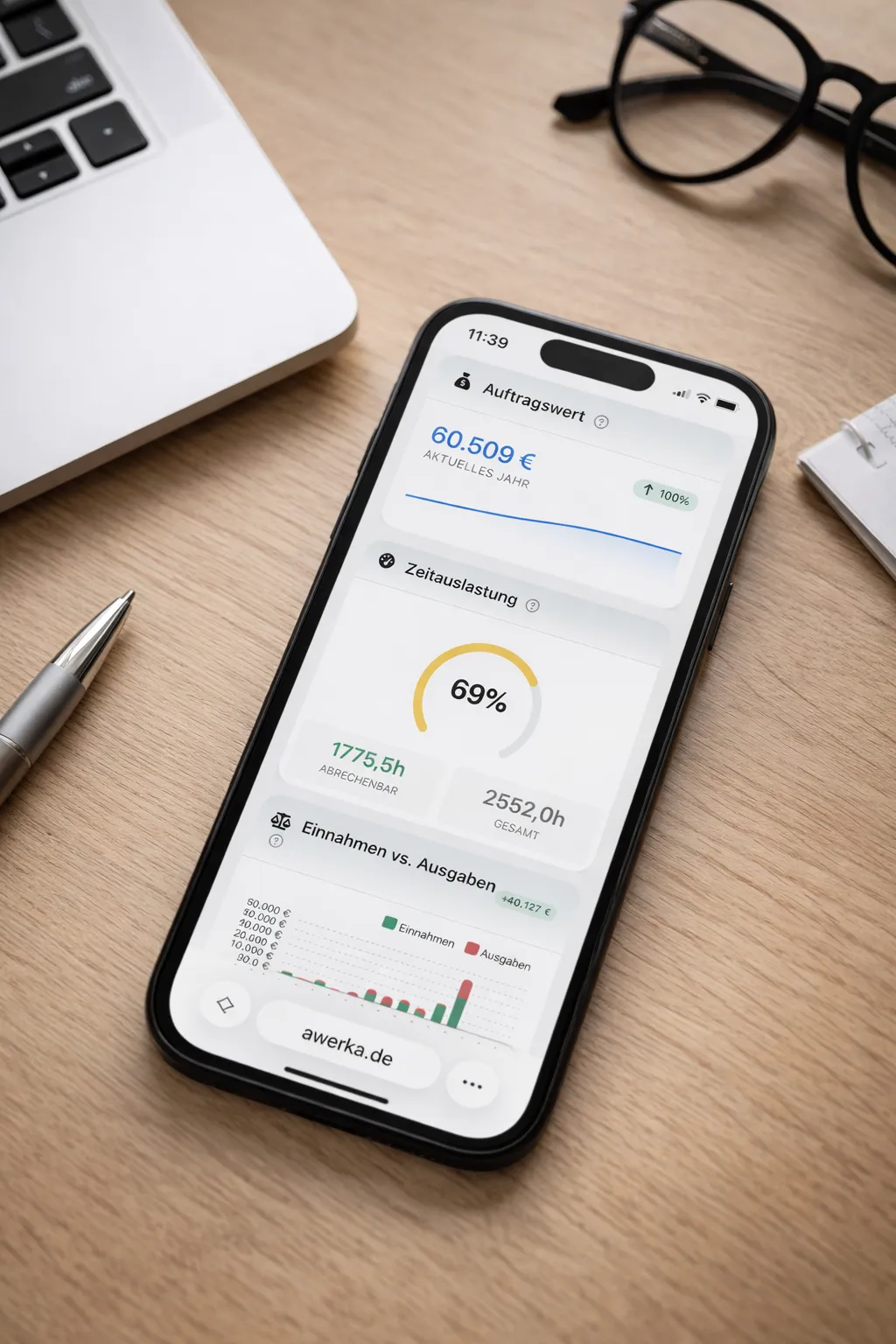
Awerka for Mobile

Manage your business on the go. Access customers, projects, and time tracking from anywhere with our mobile app.


Awerka business overview on mobile and desktop